In 2005, a farmer in Sinauli (also called Sanauli) village of district Bhagpat in Western Uttar Pradesh was plowing his agricultural land when he stumbled upon shards of pottery, human skeletal remains, fragments of copper, and other artifacts. Now imagine the reaction of the local farmer, a simple tiller of the soil, whose hands were accustomed only to the texture of grain, suddenly striking something harder than stone! He was gobsmacked! The news of this accidental discovery spread far and wide. Without delay, the Archaeological Survey of India (ASI) landed at the spot and carried out the first excavation that would rewrite history and debunk many myths along the way.
The first systematic excavation of Sinauli was conducted by the ASI in 2005. This excavation exposed 116 burial sites hinting at a communal burial ground. The massive burial site unearthed around 100 human skeletons, large amounts of Harappan-style pottery (jars, bowls, dish-on-stands), wide range of jewelry (Gold bracelets, Copper bangles and necklaces made out of semi-precious stones like Carnelian and Agate) and various Copper objects with the Copper antenna sword being the major finds of the excavation as it confirmed the site’s relation to “Copper Hoard Culture”.
However, the groundbreaking excavation in 2018, about 100 meters from the previously excavated graveyard at Sinauli, brought to light seven more graves, believed to be a royal cemetery. The most sensational find of this excavation was three full-sized chariots! This was a revolutionary discovery as it provided physical evidence for the long-held belief in a warrior-centric culture in the Indian subcontinent dating back to roughly 2000-1800 BCE.
I am not going to delve into the other finds of the excavation with as much enthusiasm as I am going to when it comes to the Sinauli chariots, solely for the fact that no other discovery has rocked the western boat as much as this did! Well, we”ll come to this in a short while. But first, how have these chariots managed to remain intact all these years? Were they horse or bull driven? Were they used for wars, processions or rituals?
The chariots were not just made of bare wood; they were extensively reinforced and decorated with copper inlays (triangular patterns) and plating. The copper acted as a protective skin, shielding the wood from direct abrasive forces of soil and moisture. The chariots were found within deep, meticulously constructed brick-lined burial pits. Once sealed, these chambers created an anaerobic (oxygen-poor) environment. Since the bacteria and fungi that typically decompose wood require oxygen to thrive, their decay process was significantly slowed down or halted entirely.
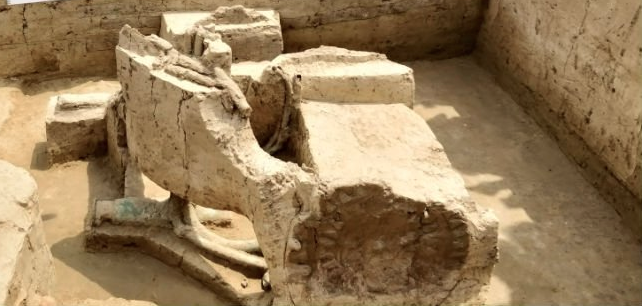
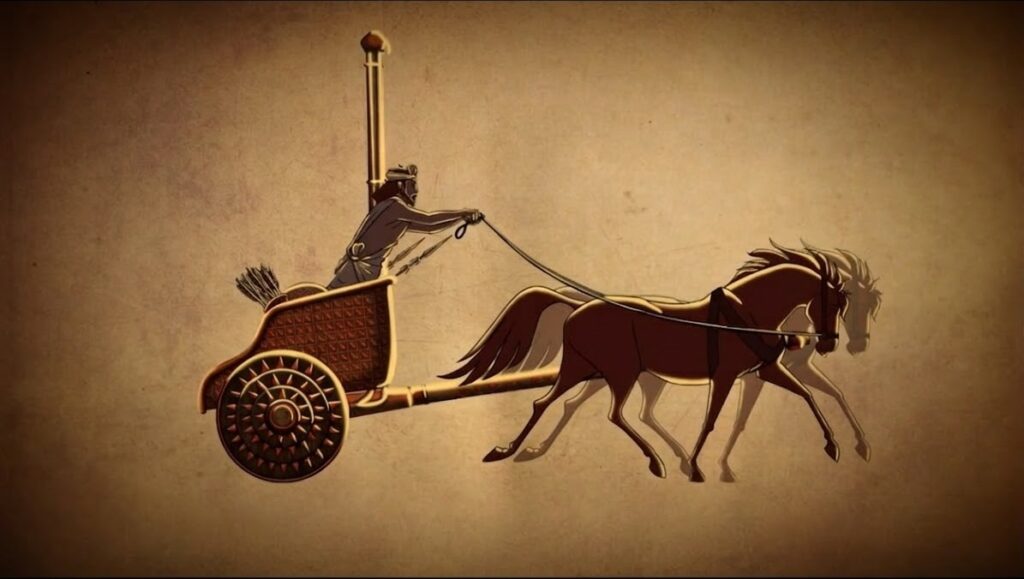
The question of whether the Sinauli chariots were drawn by horses or bulls is one of India’s most intense archaeological debates, as it impacts our understanding of the Vedic period and the “Aryan Migration” theory. Proponents of the horse-driven theory state that the structure of the chariot is such that it could have only been driven by horses. The length of the pole and the yoke that was found in the burial pit is more consistent with the gait of a horse rather than a bull. However, they were bull-driven, is suggested on the premise that no horse skeletons or horse skulls have been found at the burial site.
The presence of copper helmets, shields and “antenna” swords suggest a warrior-class culture prevalent in Sinauli which is exclusively associated with horse-drawn chariotry. The wheels found at Sinauli are solid, not spoked. While technologically advanced for their time, spoked wheels are usually considered the “gold standard” for the high-speed horse chariots seen in later Bronze Age civilizations. Regardless of the animal, the discovery proves that a sophisticated, chariot-using “warrior culture” existed in the Ganga-Yamuna Doab much earlier than previously thought.
The monumental discovery of chariots took head-on, the theory of Aryan Invasion. Since the beginning of man’s understanding of his ancient past, the Western Philologists and Archaeologists have tried to create a narrative wherein it is presented that “civilization” and horses were imported into India by the Aryans! The Aryan Migration Theory propounded that these migrants brought with them the Sanskrit language, the Vedas, and advanced metallurgy.
The scholars argued that since there were no horses on the seals of the Harappan civilization, and as horse remains could not be found at any of these sites, horses were not native to India. The theory relies on the horse and chariot arriving after the decline of the Harappans; however, Sinauli places the chariots during the late Harappan phase. If a sophisticated chariot-using warrior class already existed in the Ganga-Yamuna Doab by 2000 BCE, the theory that horses and chariots were a “gift” from later migrants loses its primary footing. And hence, the Western scholars are rattled for years to come!
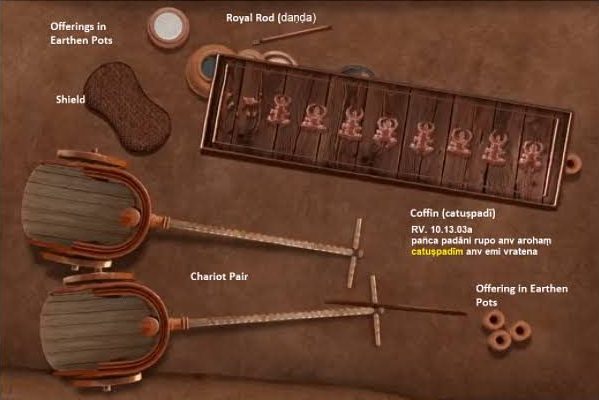
The Sinauli chariots are placed around 2100-1900 BCE, which narrows the gap between archaeology and the epic Mahabharata. It suggests that the warrior culture depicted in epics wasn’t a myth, but a reality during the late Harappan period. The warrior burials of “antenna” swords, helmets, shields, etc., mirror the ‘Kshatriya’ paraphernalia described in the ancient Indian texts. Much like the royal kingdoms of Kurus and Pandavas, the elaborate Sinauli burial suggests a ‘royal chiefdom’. Also, Bhagpat (where Sinauli is located) was 1 of the 5 villages demanded by the Pandavas to avoid the Great War. Sinauli’s close proximity to the Kuru-Panchala region lends it immense geographical weight. In fact, this culture is not only typical of the Mahabharata, but also the Rigveda mentions battles, warriors, chariots (rathas), and spears.
The large size of the burial ground at Sinauli as well as the various types of burials unearthed here is suggestive of the fact that either there is a very large Harappan urban centre near this site which has still not been discovered and needs further filed study, maybe even as large as Harappan itself in view of the large area covered by the burial ground. Or alternatively, this is a common burial ground for many small Harappan centers all around this site which need to be identified.
The copper-clad chariots of Sinauli are more than mere relics of a forgotten burial; they are the silent witnesses to a sophisticated, indigenous martial culture that thrived in the Ganga-Yamuna Doab four millennia ago. By pushing back the timeline of advanced chariotry in the subcontinent, these finds do not just challenge old colonial narratives—they dismantle them.
As we look at the intricate copper inlays and the sturdy frames that survived the weight of centuries, the boundary between the “mythic” age of the Mahabharata and the “archaeological” record begins to blur. Sinauli reminds us that the history of India is not a story of what was brought in from the outside, but a testament to what was built, defended, and hallowed on this very soil. The dust has settled on the burial pits, but the wheels of Sinauli continue to turn, driving a new and more authentic understanding of India’s ancient past!
No responses yet