“ If a strong man were to throw four stones, one to each of the cardinal points, North, South, East and West, and a fifth stone vertically, and if the interspace were to be filled with gold and precious stones, they would not equal in value the Koh-i-noor.”
Wa’fa begum (Queen consort of Shaj Shuja Durrani)
This was the response wa’fa begum gave to Maharaja Ranjit Singh when asked to value the invaluable and enigmatic ‘Koh-i-noor’ which he extracted out of Shah Shuja Durrani, the last Persian possessor of the fabled diamond. Koh-i-noor or ‘Mountain of Light’ (rightly named so by Nader Shah when he marauded the streets of Delhi and looted the magnificent ‘Peacock throne’ along with other valuable jewels and cash) has been witness to centuries of plunder, bloodshed, deception, trickery and subterfuge. Empires were built and monarchs were replaced but the one thing that remained perpetual was the desire to possess ‘Koh-i-noor’. So what is the Koh-i-noor conundrum? Is it as trophy of vanquishment? A symbol of power? A relic of destruction? Or a wound that has not healed yet?
The journey of Koh-i-noor from the land of its origin to the jewel house at the Tower of London has been nothing short of a Magnum Opus where the empires faded, Kings turned to dust but the diamond remains.
The origin of Koh-i-noor has long been a matter of speculation among the scholarly circles. Some trace its origin to the mythological texts Bhagvada Purana and Vishnu Purana where in the fabled gem was once the ‘Syamantaka Mani’, meaning ‘the prince of gemstones’, and was worn by ‘Surya’, the Sun god, around his neck and instantly became a dazzling display of luster and shine. The same texts suggest that Koh-i-noor first came down to earth when Satrajit, the Yadava King of Dwarka was gifted the mani as a token of endearment by the Surya god himself. The gem then fell into the hands of Jamavat, then Krishna and later the Pandavas who later gifted the same to the King of Kashmir.
In another version of its origin, the diamond originated in the mines of Golconda of the Kakatiya kingdom and later fell into the hands of the Khilji dynasty. In all the versions, the history of Koh-i-noor is one of greed, rapacity and horrifying bloodshed!
By the sixteenth century we find the references to Koh-i-noor in the work of the remarkable Portuguese doctor and natural philosopher, Garcia da orto (1501-68) – Colloquies on the Simples and Drugs of India (1561), in which the author elaborated on end the truth about the diamonds and mentioned of a diamond he saw in Vijayanagara, the size of which was roughly the size of a small hen’s egg. By the second half of the sixteenth century, the stories of the incredible and unbelievable beauty of Koh-i-noor had travelled the land far and wide making it the most coveted item of conquest and war. With the arrival of Babur in the Indian subcontinent and the consequent defeat of Ibrahim Lodhi in the first battle of Panipat in 1526, the Mughal Empire was established and in it, Koh-i-noor saw its new masters for the next 300 years.
The Mughals had brought with them a very different idea of gemstones. They had specific interest in collecting the greatest of the gems in the world including rubies, spinels, pearls, emeralds etc with diamonds holding no pre-eminence. However, that changed when the treasuries were filling up fast because of the diamonds! Amongst the earlier Mughal rulers Jahangir and Shah Jahan were passionate connoisseurs of precious stones and patronized the collection of the rarest of the gems. The possession of these gemstones not only signified the growth in the treasury of these kings but also gave rise to a sense of pride and glory in each one of them. The rarer the gemstones were, the more elevated the status of the ruler was. In 1628, the love of the Mughals for these precious stones reached a climax when Shah Jahan commissioned the most eye-catching and arresting bejeweled thing ever made in the history of mankind – ‘The Peacock Throne’. The throne completed in the course of seven years and at a cost of 100 lakh rupees eventually became the most desired object of exquisite nature and the famed diamond gain more prominence and was forever etched in the memory of mankind.
The death of Aurangzeb in 1707 marked the beginning of the end of the Mughal Empire and the possession of Koh-i-noor was in the hands of the decimated and debilitated rulers who reveled in debauchery and extravagant spending of the Mughal treasury. The Koh-i-noor left the hands of the Mughals when the Persian invader Nader Shah defeated Muhammad Shah ‘Rangeela’ in the battle of Karnal in 1739 and took away the ‘Peacock Throne’ embedded with Koh-i-noor and other precious jewels. It was the first time in centuries that Koh-i-noor left the land it once inhabited and was taken to Afghanistan where it remained in the possession of the Persians for forty years until Maharaja Ranjit Singh acquired it from Shah Shuja Durrani in 1813 and brought the diamond back to the land where it had left a trail of destruction and bloodshed.
The great maharaja of the Sikhs popularized and hyped the Koh-i-noor in a way that it soon became a symbol of sovereignty. It was during his reign that the diamond gained the fame and status it has never given up till today. In a report “Account of the Koh-i-noor while it was in the possession of the Lahore durbar” to the secretary to the board of administration for the affairs of Punjab by the Deputy Commissioner of Lahore dated 14 June, 1850, states “The koh-i-noor was procured and worn by Ranjit Singh as an armlet the Dusserah and other great festivals, and it was always exhibited to visitors of distinction, especially to British Officers who visited his court. Ranjit Singh took the Koh-i-noor with him wherever he travelled to mooltan, Peshawar and other places.”
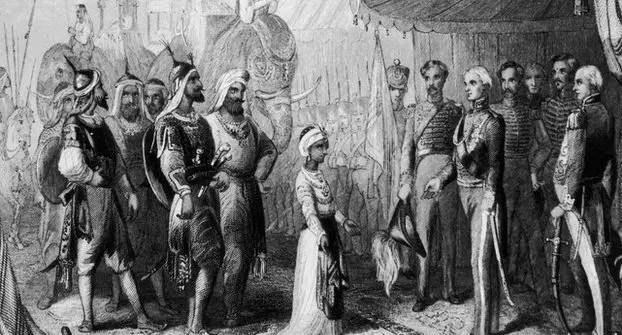
With the death of Maharaja Ranjit Singh, the sikh empire was tottering to its fall with Britishers waiting for the opportune moment to strike on the Sikh empire and acquire Punjab which had always been away from their clutches till the time the maharaja was alive. To accomplish their nefarious plans of acquiring Punjab now that the Maharaja was dead, they put up small encampments by the Sutlej and eventually it turned into a massive army. The Sikhs resented this and saw this as an act of aggression and violated the Sutlej treaty and what followed were a war of treachery and deceit ending in bloodshed and two Anglo-Sikh wars with British finally annexing the kingdom of Punjab with shrewd maneuvering and duplicity. The treaty of Lahore dated 29 March, 1849 was the last nail in the coffin and the legendary Koh-i-noor was lost to the British forever. Maharaja Duleep Singh, the young prince who was anointed king at the age of five had lost his kingdom, separated from his mother and his own blood even before he could comprehend the treachery of the British.
The treaty had the demand of Koh-i-noor high on the list and the young prince was forced to surrender the gem his father had so fiercely preserved and treasured. Thus came to an end, India’s tryst with Koh-i-noor, the diamond that was coveted by kings and monarchs alike. Truly, the bling that broke empires!
Aboard the ship Medea, Koh-i-noor travelled the last leg of its journey to London where it would find its resting place. Koh-i-noor or the mountain of light was finally presented to Queen Victoria and worn by the succeeding females of the royal family (the curse had taken root by then that women could wear it with impunity but would destroy any man who wore it). It became an emblem of sovereignty and a symbol of pride and power for the British. All that was acquired with deception and trickery!
Britain, the champion of Colonialism, swindled exquisite artifacts from all across the countries it once colonized. The magnificent Benin Bronzes form Nigeria, the spectacular Parthenon Marbles from Greece, and the majestic Rosetta stone from Egypt are just a few examples of how Britain ‘stole’ the very culture and heritage of the nations across the world and it need not be said that it had no qualms whatsoever about adorning their museums with these stolen artifacts!
Governments and activists have since made repeated requests for the repatriation of these cultural artifacts all of which fell flat. Koh-i-noor is not only an invaluable piece of gem that rightly belongs to India but also a potent symbol of our nation’s colonial subjugation and the plunder of its wealth by the British Empire. Bringing up the treaty of Lahore which in every bit was a ‘scam’, every time we request for the repatriation of Koh-i-noor to the land it actually belongs does not change the fact that acquiring it from the child king, Maharaja Duleep Singh was not an act of gifting or voluntary exchange, but an act of coercion by imperial Britain! An act of isolating, badgering and arm-twisting!
Yes, Koh-i-noor is a constant reminder of the historical injustice and imperial subjugation, a reminder of the hopes, conflicts and legacies of the people who once possessed it but most of all it is a matter of national pride, a matter of correcting historical wrongs and reclaiming our lost heritage. Koh-i-noor is a wound that time has not healed yet! And as far as the question of Britain repatriating it to India and atoning for its sins is concerned, we can never forget what David Cameroon, the former British Prime Minister of Britain said in an interview when confronted with the same question by the media, “If you say yes to one, you suddenly find the British Museum would be empty. I am afraid to say, it is going to have to stay put.” It was subtly communicated that there shall be no homecoming!
One response
Congratulations for your good endeavour.Well researched article, was impressed by the detailed history of the supposedly cursed gem. I hope to read many more of such in-depth articles.
Blessings for new venture.